Python bivittatus
PITONE MOLURO BIRMANO
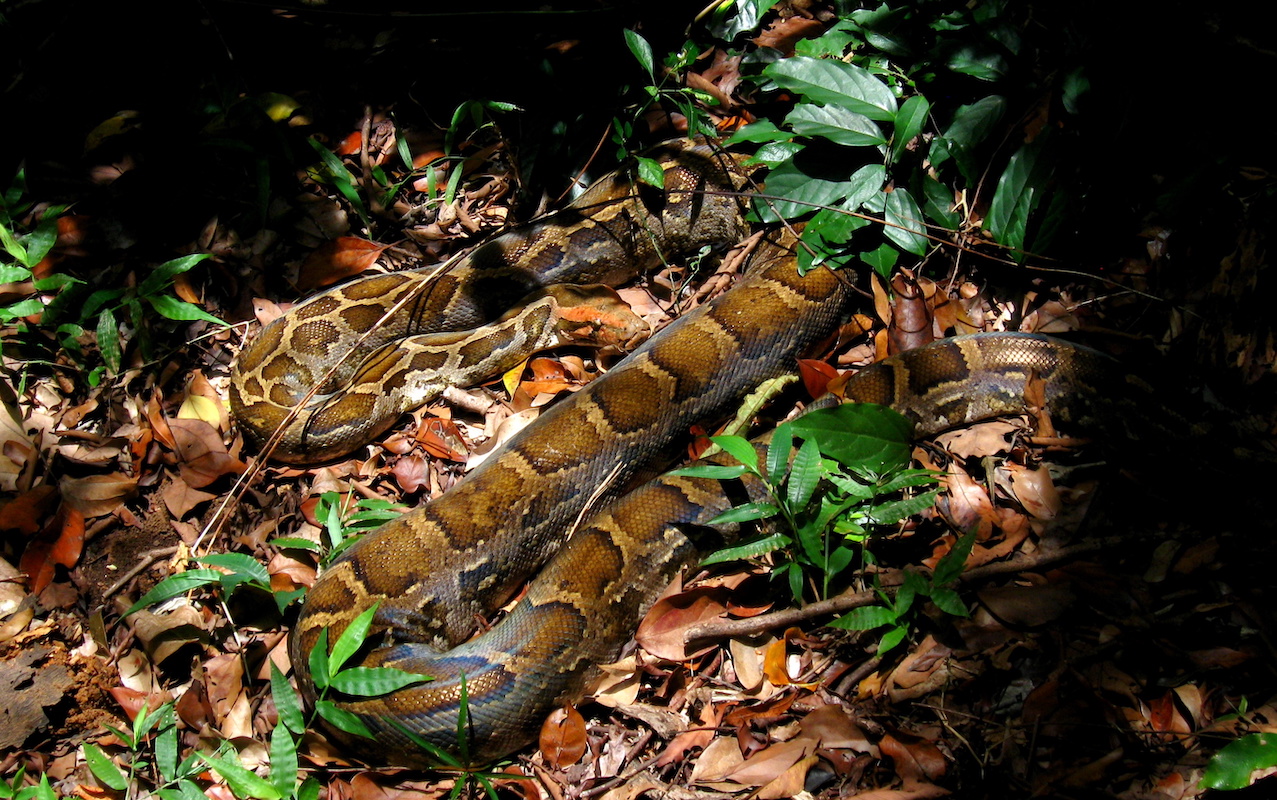
Il pitone birmano è uno dei serpenti più grossi al mondo, il terzo, se viene preso in considerazione sia il peso che la lunghezza. Gli animali selvatici sono lunghi in media 3,5 metri, ma possono sfiorare i 6 metri e raggiungere gli 80 kg di peso. E’ nativo di una vasta area del sud-est asiatico, dove spesso si trova nei pressi dell’acqua, essendo tra l’altro anche un abile nuotatore. I giovani individui tendono ad essere arboricoli. Nel sud della Florida il pitone moluro è diventato invasivo, dopo che vari individui sono stati liberati o sono scappati dagli allevamenti. Hanno trovato cibo, clima e habitat idonei e ora, con pochi predatori naturali, rappresentano una seria minaccia per la fauna autoctona.
La femmina depone tra le 12 e le 36 uova tra marzo e aprile, che circonda con le sue spire, riuscendo, tramite contrazioni muscolari, ad innalzare la temperatura di qualche grado intorno ad esse.
La dieta consiste in uccelli, mammiferi e rettili. Grossi pitoni, in Florida, riescono a cibarsi di alligatori e cervi adulti.
Le popolazioni autoctone si trovano nell’appendice II della CITES. Nella lista rossa IUCN, invece, ha la dicitura “vulnerabile”.
BURMESE PYTHON
The Burmese python is the third-largest snake in world as measured either by length or weight. Wild individuals reach an average of 3.7 m (12.1 ft) long, but have been known to reach 5.74 m (18.8 ft), and can weigh up to 75 kg (165 lb). It is native to a large area of tropical South and Southeast Asia. These snakes are often found near water and are sometimes semi-aquatic, but can also be found in trees. Python invasion has been particularly extensive across South Florida, where a large number of these snakes, escaped from hobbyists and python-farms, can now be found in the Everglades where they have been a threat for the wildlife. Females lay clutches of 12–36 eggs. They remain with the eggs until they hatch, wrapping around them and twitching their muscles in such a way as to raise the temperature around the eggs by several degrees. Their diet consists primarily of appropriately sized birds and mammals. Large pythons are known to have eaten alligators and adult deers in Florida.
The wild populations are listed on Appendix II of CITES and the IUCN has recently listed the Burmese python as “vulnerable”.
Ambiente - Environment